
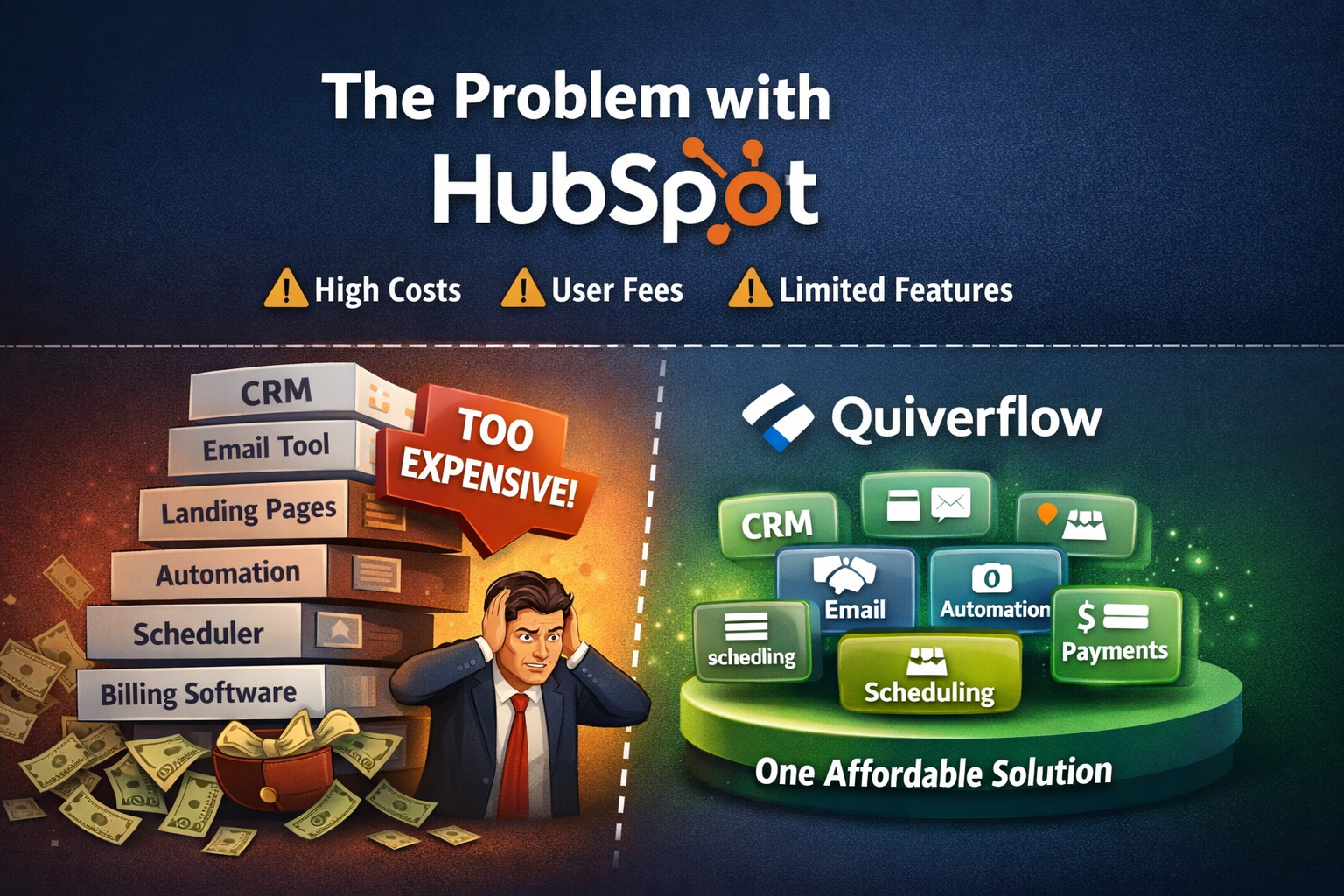
The HubSpot pricing problem has become a major obstacle for small businesses trying to grow without exploding software costs.
HubSpot is often positioned as the gold standard of CRM and marketing software. On the surface, it looks powerful, polished, and enterprise ready. But once small businesses actually try to run day to day operations on it, the cracks show quickly.
1. Why the HubSpot Pricing Problem Gets Worse as You Grow
HubSpot’s pricing model is one of the biggest pain points for small and growing teams.
You are billed:
- Per user license
- As your contact list grows
- For advanced features that most businesses consider basic
As soon as your team expands or your marketing starts working, your bill goes up. Growth becomes a liability instead of a win. Many businesses start on an affordable plan, only to find themselves paying hundreds or thousands more per month just to keep operating at the same level.
Per User Fees Create a HubSpot Cost Problem
This HubSpot pricing problem makes it difficult for small teams to scale without constantly upgrading plans. If you have ever watched your monthly bill rise just because you added a team member, you have felt the HubSpot cost problem firsthand. See HubSpot pricing.
Contact Limits Turn the HubSpot Pricing Problem Into a Growth Tax
As your contact database grows, you often end up paying more just to keep marketing to the people already in your pipeline. For many businesses, this turns the HubSpot pricing problem into a growth tax.
2. HubSpot Feature Add Ons Drive Up Costs
Core functionality is fragmented across plans and add-ons. Want better automation, reporting, or integrations? That is another upgrade. Need sales tools and marketing tools to work together properly? That usually means moving to higher tiers.
HubSpot Pricing Tiers and Locked Features
The result is a platform that feels incomplete unless you keep paying more. Many teams end up upgrading not because they want enterprise features, but because they need basic functionality to run normal operations.
3. HubSpot Cannot Replace Your Full Sales and Marketing Stack
Even after paying a premium, HubSpot still does not cover everything a modern business needs.
Most teams end up subscribing to:
- A separate email or SMS platform
- A funnel or landing page builder
- An appointment scheduling tool
- An automation platform
- A contract or e-signature tool
- An invoicing or payment system
We regularly see businesses running six to eight different tools just to support normal sales and marketing operations. That means more logins, more integrations, more points of failure, and much higher monthly costs.
How Quiverflow Solves the HubSpot Pricing Problem
Quiverflow was built specifically to remove this complexity and cost burden, especially for small businesses that need strong automation without enterprise pricing.
Many of our clients came to us already paying for:
- Multiple CRMs
- Separate automation tools
- Standalone email and SMS platforms
- Funnel builders
- Scheduling software
- Contract and document tools
After switching to Quiverflow, all of that was replaced by one platform. See Quiverflow vs. HubSpot
Quiverflow Is an All in One HubSpot Alternative
If you are looking for a HubSpot alternative that does not punish growth, Quiverflow consolidates your sales and marketing tools into one system so you can stop paying for a stacked tech setup.
One Software for CRM, Automation, and Marketing
Quiverflow combines:
- CRM with unlimited contacts
- Sales and marketing automation
- Email and SMS campaigns
- Funnels and landing pages
- Appointment scheduling
- Pipelines and reporting
- Documents, contracts, and e-signatures
- Payments, invoices, and receipts
No per-user license fees. No contact list penalties. No surprise upgrades just to unlock essentials.
Affordable CRM for Small Businesses That Want to Scale
Software costs should not be the reason a small business struggles or fails.
Quiverflow is:
- Extremely affordable compared to enterprise CRMs
- Robust enough to replace an entire tech stack
- Flexible enough to adapt to different industries and workflows
Instead of spending money just to keep tools connected, businesses can focus on growth, sales, and customer experience.
The Bottom Line on the HubSpot Pricing Problem
HubSpot may work for large enterprises with massive budgets. But for small and medium businesses, the pricing structure, feature gating, and dependency on multiple external tools often do more harm than good.
Quiverflow gives businesses what they actually need:
- One platform
- One bill
- No growth penalties
When software stops being a burden, small businesses finally get a fair shot at succeeding.






0 Comments